Free Meeting Notes, Agenda & Action Items Template
A structured meeting notes template turns unfocused calls into crisp decisions and accountable follow-through by combining a 5-minute silent pre-read, a timeboxed agenda, a permanent Decision Log, and an Action-Item Tracker with one owner and deadline per row. Build your agenda and calculate live meeting cost below, copy formatted notes to Slack or Notion, or print our free A4/US Letter PDF sheet.
Interactive Meeting Agenda, Decision Log & Action-Item Builder (Free PDF, Slack & Notion Export)
Configure your meeting cadence, attendees, decisions, and owner-assigned action items below, then print a 1-page PDF or copy formatted notes for Slack / Notion.
What’s in the template
- 5-Minute Silent Pre-Read Header: Replaces 15 minutes of slide-reading with a silent 1-page brief review at the start of the call.
- Live Meeting Cost & Person-Hours Calculator: Converts attendee headcount and call duration into real person-hours and dollar cost so teams keep invite lists lean.
- Permanent Decision Log (DEC-01…): Captures the exact decision agreed and its Directly Responsible Individual (DRI) separately from general discussion notes.
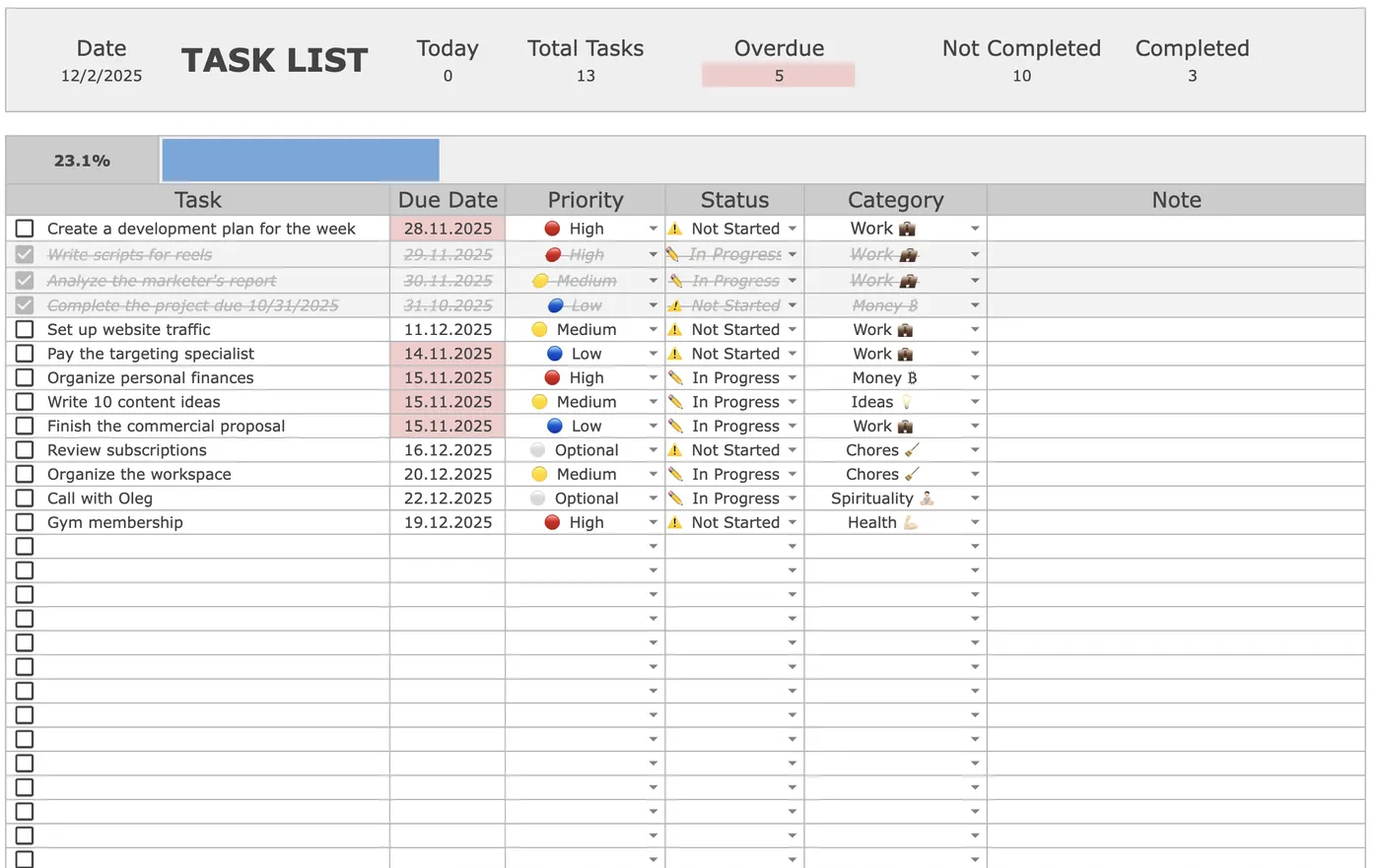
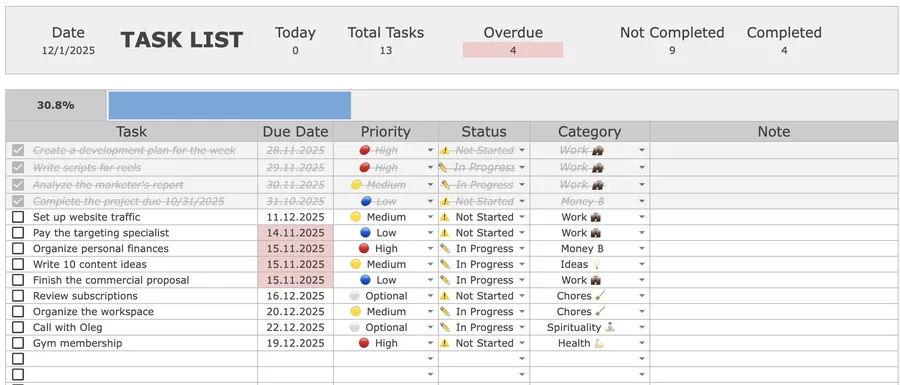
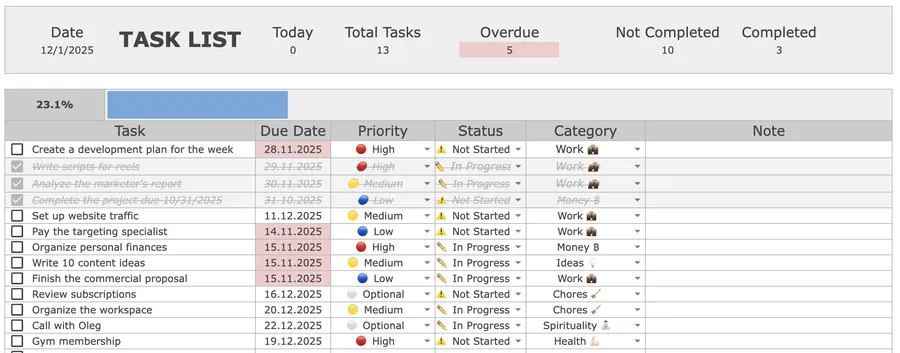
- Accountable Action-Item Matrix: Requires a concrete verb, a single owner (never “Team”), and a due date for every follow-up task.
How to run a 25-minute meeting that finishes on time
- No agenda, no attenda: State the single question or decision the meeting exists to resolve in the calendar invite and link a 1-page pre-read.
- Start with 5 minutes of silent reading: Let attendees read the brief silently from 00:00 to 00:05 so everyone debates from the same baseline facts.
- Separate decisions from brainstorms: Park tangential ideas in the Parking Lot box and lock concrete decisions into the Decision Log.
- Reserve the final 3 minutes for Action Readback: Read back every action item with its owner and due date, then push those tasks into your Task Tracker or Project Tracker.
Up close

Meeting Format Comparison: Decision Sync vs. 1-on-1 vs. Stand-Up vs. Async Memo
| Meeting format | Ideal duration | Ideal headcount | Primary output |
|---|---|---|---|
| Decision / Architecture Sync | 25 or 50 min (5 min pre-read) | 3–6 decision-makers | Locked DEC rows + owner-assigned action items |
| Manager 1-on-1 Coaching | 25 min weekly | 2 people | Unblocked priorities, career feedback & 2–3 next actions |
| Daily Blocker Stand-Up | 10–15 min | 4–8 squad members | Today’s commitment + immediate blocker handoffs |
| Async Written Memo / Loom | 0 min live (5 min read) | Unlimited FYI stakeholders | Shared context without fracturing Maker deep-work blocks |
3 rules to eliminate unproductive status meetings
Most calendar bloat comes from using synchronous multi-person calls for one-way status reporting. Apply three structural guardrails before sending any calendar invite:
- The 7-Person Decision Rule: Once a meeting passes 7 participants, each additional attendee reduces decision speed while multiplying person-hour cost. Move pure observers to an optional Async Notes FYI list.
- Never assign an action item to two people: An action item assigned to “@sarah and @alex” almost always falls through the cracks. Assign one Directly Responsible Individual (DRI) who owns completion, even if others contribute.
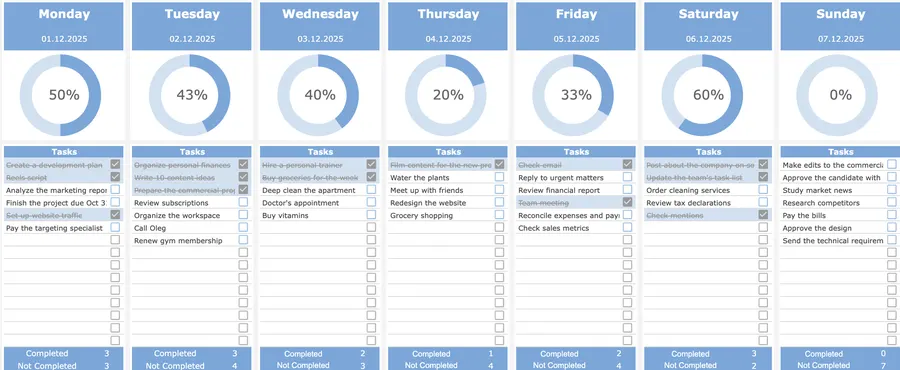
- Cluster calls into a single Manager window: Stack your 25-minute syncs back-to-back in your midday collaboration window on your Time Blocking Schedule and Weekly Planner so morning deep-work hours remain untouched.
What organizational research proves about meeting overload and structured agendas (Rogelberg et al. & Perlow et al.)
Unstructured, excessive meetings impose both a direct payroll cost and a hidden cognitive recovery tax. In empirical research examining time demands and employee well-being across knowledge workers, organizational psychologists Steven G. Rogelberg, Desmond J. Leach, Peter B. Warr, and Jennifer L. Burnfield demonstrated that poorly structured meeting demands significantly increase perceived workload fatigue and reduce daily job satisfaction, particularly for accomplishment-oriented professionals whose primary tasks are interrupted (Rogelberg et al., 2006, Journal of Applied Psychology; Leach, Rogelberg, Warr, & Burnfield, 2009, Small Group Research). Likewise, field research by Harvard Business School professor Leslie A. Perlow and colleagues Constance Noonan Hadley and Eunice Eun across executive and product teams found that auditing recurring calls, enforcing clear agendas, and protecting meeting-free focus blocks significantly raised autonomy, team communication clarity, and on-time deliverable output (Perlow, Hadley, & Eun, 2017, Harvard Business Review).
Frequently asked questions
Is this meeting notes and action items template free to download?
Yes. You can plan your timed agenda, calculate real-time meeting cost, record decisions, and assign action items in the interactive builder on this page, copy your formatted minutes directly into Slack, Notion, or Markdown, or print the 1-page A4/US Letter PDF sheet for free. If you want an automated multi-project action tracker in Google Sheets with overdue highlights and owner filters, get the Focus Protocol Task & Action Tracker for a one-time $9.
What is the difference between meeting minutes, a decision log, and an action item tracker?
Traditional meeting minutes transcribe everything said in chronological order, which nobody re-reads. A high-leverage meeting template separates three distinct outputs: a timed agenda with a 5-minute silent pre-read, an explicit Decision Log (recording what was agreed and why so teams do not re-litigate it next month), and an Action-Item Tracker where every task has a single Directly Responsible Individual (DRI) and a concrete deadline.
Why should meetings default to 25 or 50 minutes instead of 30 or 60 minutes?
Back-to-back 30- and 60-minute calls eliminate transition time, forcing attendees to arrive late and carry cognitive residue from the previous conversation. Defaulting to 25 minutes (for stand-ups and 1-on-1s) or 50 minutes (for decision reviews) enforces Parkinson’s Law compression and protects a 5- to 10-minute buffer to log action items and reset before your next block.
How does a 5-minute silent pre-read improve meeting quality?
Asking attendees to read a 1-page deck before the call rarely works because busy teammates arrive from other meetings unprepared. Opening the meeting with 5 minutes of silent reading ensures every participant shares the exact same data and context before discussion begins, cutting status-update rambling by 50% or more.
When should a meeting be canceled and replaced with an asynchronous update?
Cancel the live call whenever the sole purpose is one-way information sharing (status readouts, metric updates, or FYI announcements) and no real-time debate, trade-off resolution, or relationship building is required. Replace pure status meetings with a 3-bullet written update in Slack or your Project Tracker.
Want the complete Focus Protocol system?
Get the automated Task & Action Tracker for Google Sheets ($9), or combine it with our Project Tracker, Time Blocking Template, Weekly Planner, Daily Planner, and Goal Tracker in the All-in-One Bundle ($29).