Free Goal Tracker & 12-Week OKR Template
A goal tracker template bridges the gap between ambitious quarterly objectives and Tuesday-morning execution by pairing at most 3 keystone goals (lag outcomes) with controllable weekly lead indicators, a W1–W12 execution scorecard, and an 85% weekly target. Print our free A4/US Letter 12-week PDF sheet, map your OKRs in the builder below, or automate streak and progress tracking in Google Sheets.
Interactive Quarterly & 12-Week Goal Tracker Builder (Free PDF, Markdown & CSV Export)
Define up to 3 keystone goals, their weekly lead indicators, and current milestone progress below, then print a 1-page PDF or copy as Markdown / CSV.
What’s in the template
- 3 Keystone Objective Cards (Lag Metrics): Caps quarterly ambition at three high-impact outcomes so your weekly deep-work blocks stay concentrated.
- Controllable Weekly Lead Indicators: Connects every 90-day goal to a specific weekly action count (such as 4 deep-work blocks or 15 client outreach calls).
- W1–W12 Execution Scorecard & 85% Rule: A 12-column weekly checkbox matrix that scores weekly execution rather than waiting until the end of the quarter to discover a stall.
- Built-In WOOP Obstacle & Retro Boxes: Pre-commits to an If-Then recovery plan before friction hits and captures lessons at Weeks 4, 8, and 12.
How to run a 12-week goal review in 15 minutes
- Write measurable lag outcomes: Replace vague wishes like “Grow business” with specific numbers and deadlines (“Add $15k MRR by Week 12”).
- Schedule lead indicators onto your calendar: Every Sunday or Monday, place your weekly lead actions directly into your Weekly Planner and Time Blocking Schedule.
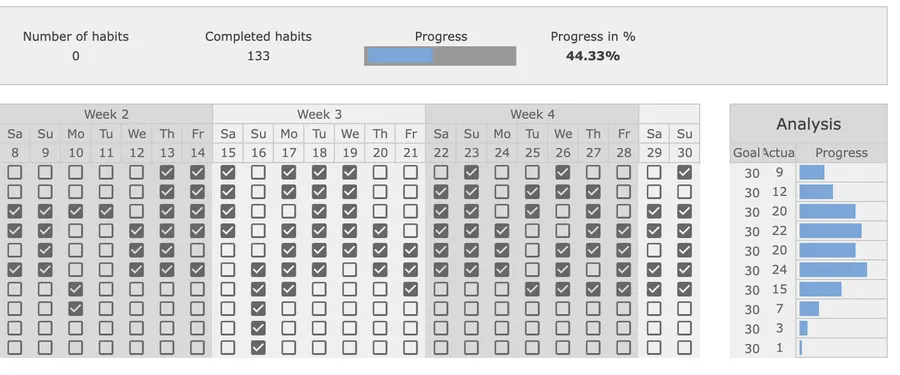
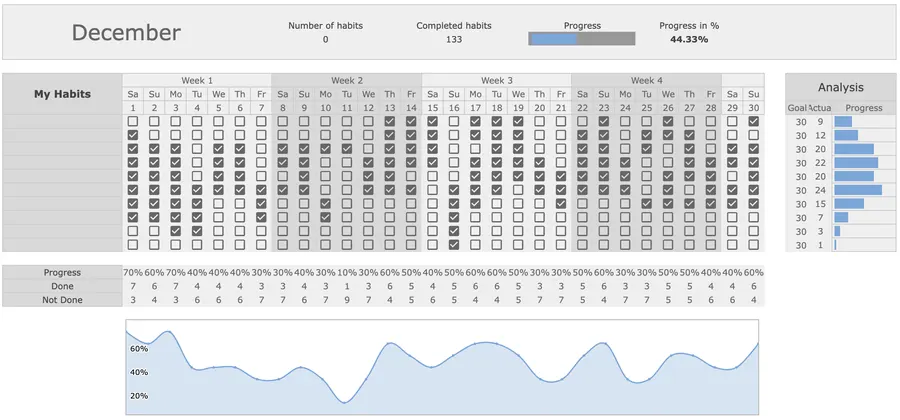
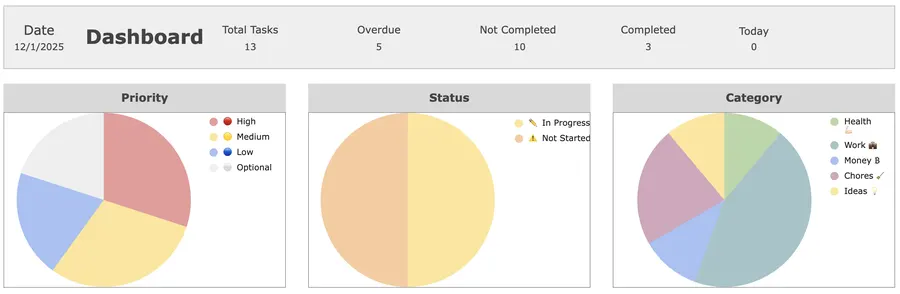
- Track daily habits alongside quarterly rocks: Use our Habit Tracker for daily routines and our Project Tracker for multi-step deliverables.
- Grade your weekly lead score every Friday: Count how many scheduled lead actions you completed out of your weekly total and aim for 85% or higher.
Up close
Framework Comparison: 12-Week Sprint vs. Quarterly OKRs vs. SMART Goals vs. Annual Goals
| Framework | Time horizon | Best for | Key trade-off |
|---|---|---|---|
| 12-Week Goal Sprint | 12 weeks (84 days / 1 quarter) | Founders, creators & individual execution | High weekly urgency; requires ruthless 3-goal prioritization |
| Quarterly OKRs | 13 weeks (Q1–Q4) | Cross-functional product & engineering teams | Aligns company-wide Key Results; can become bureaucratic if over-nested |
| SMART Goals | 4–26 weeks | Single well-defined career or fitness milestones | Clarifies the target endpoint, but often omits weekly lead indicators |
| Annual Resolution List | 52 weeks (1 year) | High-level life direction & multi-year themes | Low weekly urgency in Q1–Q2; over 80% of unmonitored annual lists stall by March |
How to pair Lag Outcomes with Weekly Lead Indicators
Most goal templates fail because they only write down the final scoreboard number (the lag indicator) without specifying the weekly behavioral inputs (the lead indicator) that move that scoreboard. Use this two-column translation for every goal on your sheet:
- Product & Engineering: Lag Outcome = “Launch v2 onboarding flow and lift activation from 28% to 40% by Week 12.” → Weekly Lead Indicator = “Complete four 90-minute deep-work build blocks and run 3 user onboarding interviews every week.”
- Revenue & Freelance Growth: Lag Outcome = “Close $30,000 in new retainer contracts in Q4.” → Weekly Lead Indicator = “Send 15 personalized diagnostic audits and follow up on 5 open proposals every Tuesday and Thursday morning.”
- Health & Personal Finance: Lag Outcome = “Save $6,000 in emergency reserves and run a 48-minute 10K.” → Weekly Lead Indicator = “Auto-transfer $500 on payday in your Finance Tracker and complete 3 structured run sessions + 2 strength sessions per week.”
What goal-achievement research proves (Locke & Latham, Harkin et al., and Oettingen)
Decades of empirical psychology explain why specific, monitored 12-week goals outperform vague intentions to “do your best.” In their landmark 35-year synthesis of goal-setting theory across more than 400 studies, psychologists Edwin A. Locke and Gary P. Latham demonstrated that specific, challenging goals consistently produce higher performance than ambiguous goals because they direct attention, mobilize effort, and increase persistence (Locke & Latham, 2002, American Psychologist). Furthermore, in a meta-analysis of 138 studies (N = 19,951), Benjamin Harkin and colleagues proved that frequent progress monitoring (particularly when recorded physically on a chart or spreadsheet) significantly increases goal attainment (Harkin et al., 2016, Psychological Bulletin). Finally, combining your goal with mental contrasting and implementation intentions (WOOP) (anticipating the primary obstacle and writing a concrete If-Then plan) doubles follow-through compared with positive visualization alone (Oettingen & Gollwitzer, 2006).
Frequently asked questions
Is this goal tracker and 12-week OKR template free to download?
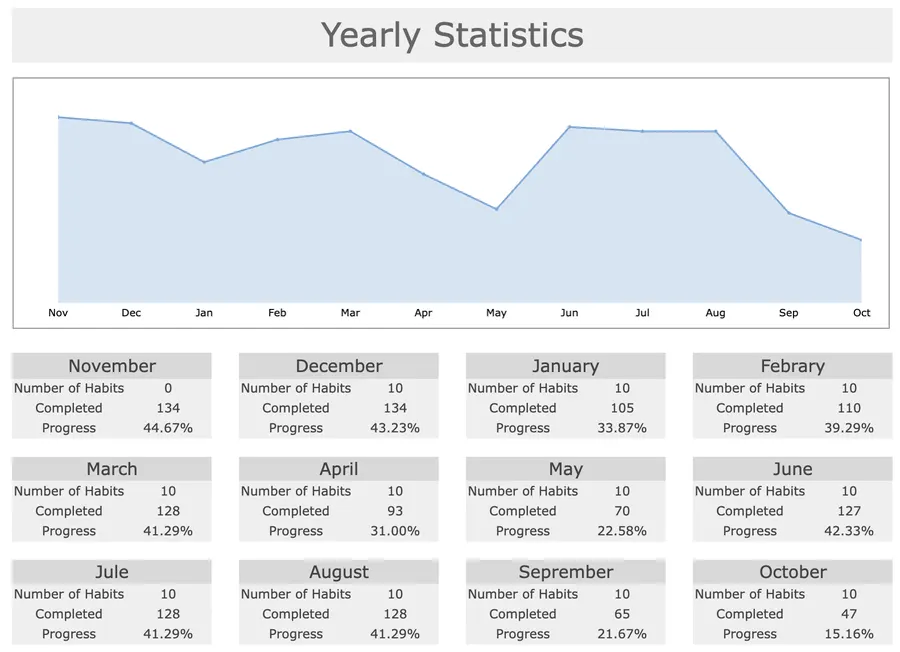
Yes. You can define your 3 keystone objectives, weekly lead indicators, and milestone percentages in the interactive builder on this page, export a clean 1-page A4 or US Letter PDF for free, or copy your OKR table to Markdown/CSV. If you want automated daily and weekly streak tracking, progress bars, and 12-month roll-up charts in Google Sheets, the Focus Protocol Habit & Goal Tracker is a one-time $9 purchase.
Why does a 12-week goal tracker work better than an annual resolution list?
Annual goals suffer from a 12-month horizon: in January, December feels so far away that there is no urgency to execute in Week 2 or Week 3. Compressing your planning cycle into a 12-week (90-day) sprint makes every single week count as 8.3% of your entire cycle, turning vague annual wishes into concrete weekly actions.
What is the difference between a lag outcome and a weekly lead indicator?
A lag indicator is the final result you want to achieve at the end of the quarter (for example, “Sign $50,000 in new client revenue” or “Run a sub-50-minute 10K”), which you cannot directly control on a Tuesday morning. A weekly lead indicator is the repeatable, controllable weekly behavior that drives that outcome (for example, “Send 15 tailored outreach proposals per week” or “Complete 4 structured run sessions per week”).
How many goals should I track at the same time?
Cap your active tracker at 1 to 3 keystone goals per 12-week cycle, each paired with at most 2 weekly lead indicators. Chasing 8 or 10 quarterly objectives dilutes your weekly deep-work hours across too many fronts, resulting in 20% progress on everything and 0 finished outcomes.
What weekly execution score should I aim for on my 12-week scorecard?
Aim to complete at least 85% of your scheduled weekly lead indicators each week. Consistently hitting 85% or higher on controllable weekly actions almost always delivers the 12-week lag objective, even when individual weeks encounter unexpected friction.
Want the complete Focus Protocol system?
Get the automated Habit & Goal Tracker for Google Sheets ($9), or combine it with our Weekly Planner, Daily Planner, Time Blocking Template, Task Tracker, Project Tracker, and Finance Tracker in the All-in-One Bundle ($29).